 I came up with that concept when writing my last article, and I decided I kinda like it as visual aid. So here’s a more detailed chart on the subject. Click on the picture to enlarge… ^_^
[n]


I came up with that concept when writing my last article, and I decided I kinda like it as visual aid. So here’s a more detailed chart on the subject. Click on the picture to enlarge… ^_^
[n]
Posted in GRAPH
Tagged 0 TO 10, democracy-volume, graph, pumpUPtheJAM, pumpUPtheVOLUME, yellowBOOMBOXmetaphore

By popular demand, here is another comic strip, enjoy! ^_^


EXTRA-EXTRA-EXTRA- READ ALL ABOUT IT!! It’s a brand new look, with the technology4democracy logo included in the design, and BEHOLD! This blog now has got 25% more propaganda then before! Actually, it’s just a 4th tab with the name propaganda on it. Click on it if you dare. Also, I’ve upgraded this site’s URL from:
technology4democracy.wordpress.com
…to the ever shorter and snazzier: technology4democracy.com
…any-hou! Now you’re up to-date on my tek-makeover! ^-^
[n]

Posted in DECLARATION
Tagged BEFORE/AFTER, makeover, propaganda, re-cut, re-design, SNIP-SNIP!, URL
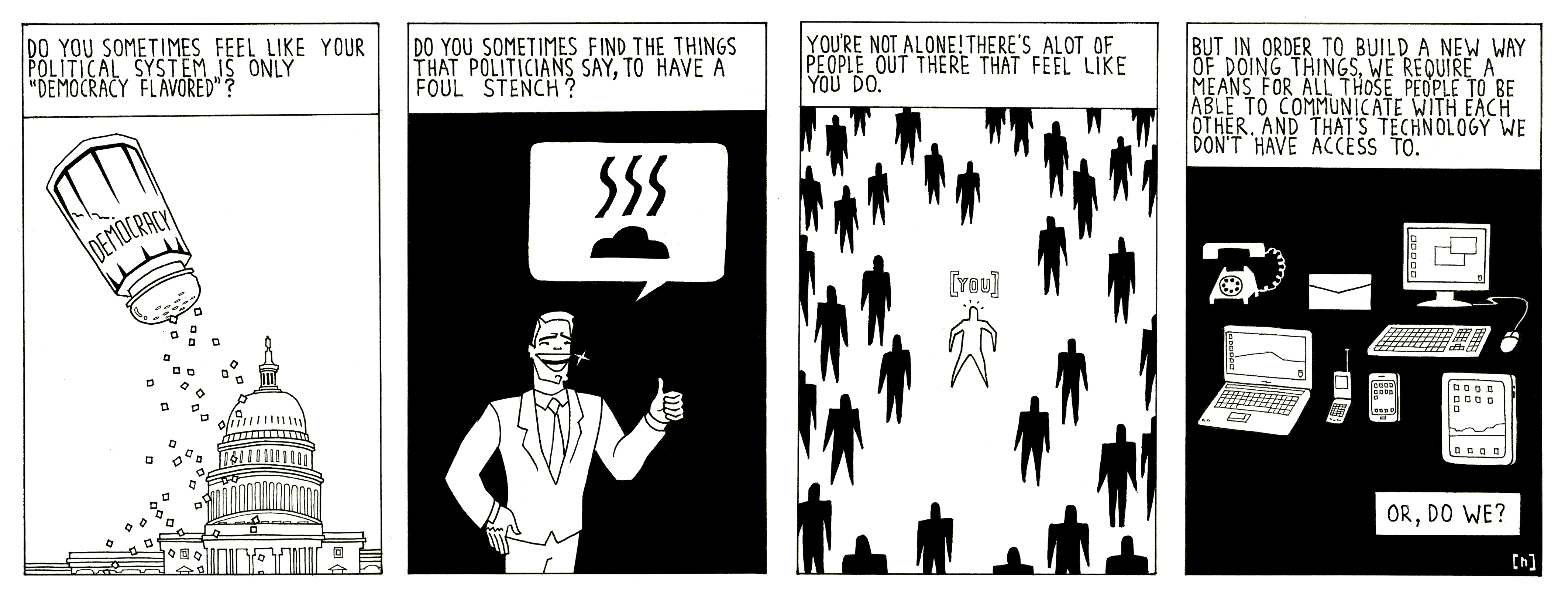
~Well, here we go, here’s a second comic strip. And as per usual, comments are quite welcomed! [n]

Posted in COMIC STRIP, COMMENTARY
Tagged 4-PANELS, COMICstrip, CONGRESS, democracy-flavored, dogpile, personal-computer, smartphones, stinky-politicians, telephone, [ YOU ]
![[ I recruit YOU ] 3](https://technology4democracy.com/wp-content/uploads/2012/05/i-recruit-you-3.jpg)
Maybe that’s a little direct, but why not? I think the modernization of our electoral system is extremely important, because IF we’re paying for it, We should have a say in it. I’m tired of politicians starting wars, and getting involved in morally questionable international situations in our names, at our monetary expense, and without any type of approval from us, the electorate. We have the technology for reform, and we can do better.
So yeah, that’s my pitch , these are my beliefs,and that’s why I want to recruit YOU! And getting recruited now-a-days isn’t about showing up at some church basement where you drink cold coffee while planning your next pamphlet-handout session. NO, this is the digital age, and if one is to promote digital democracy one should use the digital tools available. You’ve visited this page a few times, or bookmarked it, or possibly even subscribed to receive email updates, well, congratulations, you’ve been recruited! And if you talk about some of the ideas within this blog to a friend, or have sent an email with a link to it, or simply wrote a comment or clicked on the “like” button, well, thank you, you just did the cyber equivalent handing out pamphlets for the cause. And the movement for digital democracy does indeed require “knights-in-shining-armor-excellent-premium-specimens-of-humanity” such as yourselves as cyber-militants to have a chance at spreading the cause.
But hey, if you think that our current politicians and governments are doing a fine job, well, we want your opinion too. Everyone is welcomed to the debate. One cannot promote democratic reform without being willing to listen to both sides.
So, please consider this text as your digital draft notice, and please react according to the technological method you see fit. TEN-HUT!!
[n]
![[ YOU ] 3](https://technology4democracy.com/wp-content/uploads/2012/05/you-3.jpg?w=150&h=70)
Posted in DECLARATION, TEXTUALS WITH VISUALS
Tagged #9, advocacy, digital democracy, Harvey Milk hommage, Harvey Milk slogam, I-WANT-YOU!, N#9, Natacha #9, recruitment

This time around I decided to make a comic strip instead of a full-on article. It’s more art and less text for your buck. Please let me know what you think below.

 When I set out to write this article, just for argument’s sake, I tried to remember what the reason against giving women the vote was. And for the life of me I couldn’t remember what those patriarchal dinosaurs were putting forth to justify their position.
Was it because they felt men needed to dominate in the political arena to compensate for their genetic inferiority? ( Men are vulnerable to a lot of extra diseases because they’re missing an extra leg on their “Y” chromosome that would normally carry the extra data required to prevent those said diseases. ) Was it that they felt jealous of women because they get stronger orgasms? ( Women have an average of 12-15 muscle contractions during an orgasm, as opposed to 9-10 for Men. ) Were they depressed because statistically women get to live longer then men, and felt they needed to compensate?
No, after looking into it, I found out that the people who were against giving women the right to vote, were mostly doing it because they were defending what they saw as “still-valid” traditions. And any movement promoting the modernization of our political system will probably encounter similar opposition. They’ll be told that our current political systems are “still-valid”, even though most of the time they were conceived in a technological era that predates the telegraph.
I think there are similarities between the fight for women to have the right to vote, and the fight for the modern electorate to be able to have a say in what they’re paying for.
I was reading about the Canadian Suffragette movement, and what they did which was pretty clever, which is that they decided to hold “mock-parliament” sessions. They would re-enact parliamentarian procedures, but this time with women in charge. They had various parties debating whether simple creatures like men, should be allowed the responsibility of being able to vote. Basically using humor to get their point across. I’m a big fan of that.
I’m also a big fan of their “mock-parliament” idea. Doing a modern-day, online “mock-parliament” could also be a lot of fun. It could be an easy way to illustrate how a digital democracy might work. All we really need is to purchase a web-domain name, run a forum/online chat type of operating platform, you then you just add a logo. As far as the technical aspects of setting up something like that I’m sure it wouldn’t be too much of a challenge.What would get harder though, would be to get a bunch of collaborators to agree on what the structure should be for the next-gen of gov systems. Should it be structured like an online forum with the head-of-state replaced by the equivalent of a forum moderator? Or perhaps tweaking the current system, with voters being able to vote on all government law projects and programs? Or, how about we turn it around, make it that only the electorate can propose law projects, and it’s the politicians who have to decide if it goes thru or not?
Which would be the best structure?
It’s hard to say.Obviously there’s a lot of potential avenues which could serve as an appropriate soil to erect a digital democracy, the question is, which one better suited for that type of project? I don’t have the answer yet, but I think that sometimes it’s a good idea to look at the past for inspiration…
[n]

Posted in REPORT, TEXTUALS WITH VISUALS
Tagged chromosomes, cys-men, cys-women, fighting the power, gender, inspiration, mock-parliament, next-gen gov, ROTARYmonarchy, the vote, XXvsXY



 technology4democracy
A step-by-step guide to implementing a Digital Democracy
Some people might say that considering the potential challenges, it’s somewhat impossible to switch to a digital democracy. On top of the established powers that might oppose such changes, there’s also other important considerations one needs to take into account, such as economic stability and national security.Because of reasons like this , I would say one would need to start small. Implementing a digital democracy on a municipal level, rather than on a federal level, might be a lot easier to realise at first. Plus it seems like a good idea to try it on smaller scale in order to work out any potential bugs in the system.
PART 1 Upgrading your gov-system on a municipal level
To start, one would have to create an organization, recruit some members and raise some funds. Afterwards, since most municipal governmental systems are regulated on a provincial/state level, one would have to verify with those authorities to see if their existing rules prevent the switch to a digital democracy on a municipal level. If any such hurdle exist, provincial/state representatives would have to be solicited until the rules are changed. Once you’re in the clear with them, the real work starts. You find an ideal municipality, you get your organization recognized as a municipal political party and then you run for mayor. You run with the platform “Elect the last mayor that’ll take decisions for you” or something similar. Now, if enough councillors from your party got elected, as mayor you’ll be able to push the reform thru that switches the existing system over to a digital democracy pretty easily. Ideally you also have enough budget to create a municipal government portal that local citizens can access with their smartphones and personal computers in order to truly participate in the process. And it doesn’t necessarily have to be that citizens have to vote on every single law project and initiative. For the non-controversial stuff, like renewing the budget for garbage pick-up and such, well in cases like that you might have councillors/moderators that can take care of it. But when there’s a controversial issue that arises, like, let’s say, building a highway on a haunted indian graveyard, then the electorate can log on and decide the issue for themselves, with the councillors/moderators playing a role that’s more about moderating the debate than imposing their view.
One might say that this is unlikely to ever happen. But you never know. There’s small towns and villages out there, that are losing their population and are unable to find a mayor. A partnership between a political organization and an ISP, could come in, hook everyone in town to hi-speed internet, and at the same time give them access to an online voting system. And with what’s happening in a lot of small towns, I don’t think it would be too hard to find one that’s willing to have all that influx of funds, technology and resources come in into their borough. Once most of the bugs within the system have been worked out, one can then move ahead to try to apply what’s been learned to a higher level of government.
Part 2 Upgrading your gov-system on a provincial/state/federal level
This, I think, would be a lot trickier. The analogy that comes to mind for that one, is to view your government like it’s a sound system. There’s a dial for democracy on it, and it goes from zero to ten. Right now, I would say that most free countries have their “democracy-volume” set between 2.5 to 3.5, and obviously raising it at 10 all of a sudden could create quite a bit of a commotion. But if we raised it to 5 , which would be a government system peppered with a little more transparency and real-democracy, I don’t think there would necessarily be riots in the streets and economic collapse and such.
But yeah, since the stakes are higher on a provincial/state/federal level, one would be wise to proceed with baby steps. To start, you recruit members, register your organization as a political party.For argument’s sake let’s call it the Technodemocrat party. And then you run for a seat. In the off-chance your party wins more seats and gains control of your government, then you won’t have a hard time pushing for a full digital-democracy reform. But in the most likely scenario, the one in wich you’re the only member of your party elected, you can still promote the digital democracy agenda by leading by example. It’s simply a question of holding a poll, survey or referendum in your district every time you’re asked to vote as an independant.Then you vote as your district wants you to vote. And in that sense, you would actually be living up to the term “representative”.
And ultimately, maybe we don’t need a full on digital democracy, maybe if we’re lucky, maybe the threat of such a movement gaining a foothold, will be enough to scare the powers that be into increasing the democracy-volume of our governments by 0.5 . Just enough for us to have a just little more transparency and representation for our money…
[n]
Share this:
2 Comments
Posted in COMMENTARY, TEXTUALS WITH VISUALS
Tagged democracy-volume, digital democracy, gov system, next-gen gov, POWERS-THAT-BE, real-democracy, technodemocrat